
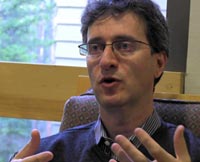
 On November 30, Milton’s Curriculum Committee invited Charles Fadel, founder and chairman of the Center for Curriculum Redesign, to spend a day with our faculty. Mr. Fadel led discussions—and asked key questions—about curricular relevance. His Center’s goal is improving education through exploring the question: What should students learn in the twenty-first century?
He and Milton’s faculty discussed what living, learning and growing up in 2015 is like for our students, and how the proliferation of technology has changed so much of what we do and how we do it. Together they talked about where students get their information and how they communicate, with one another and with adults; leveraging technology in the classroom in responsible and appropriate ways; and how curriculum today is not simply about delivering content, but about helping students tap into and develop “non-cognitive” skills, as Mr. Fadel calls them. Developing these skills, purposefully and comprehensively, in our students is a named priority for Milton.
A critical element of the Committee’s work is identifying the essential characteristics of a Milton Academy graduate, along with the skills and knowledge that our students will need for success in the future. Taking a very close look at what we teach and how we teach it; asking lots of questions; and enlisting the outside perspective of experts in this field are all key components.
Mr. Fadel and his team have collaborated with institutions across the United States and around the world, including the Harvard Graduate School of Education, MIT, Stanford, Olin College, Google, Wolfram, and the Bill and Melinda Gates Foundation. Mr. Fadel has co-authored two books: 21st Century Skills: Learning for Life in Our Times (2012) and Four Dimensional Education: The Competencies Learners Need to Succeed (2015).
“We want to identify the skills students will need to succeed when they leave here—what tools, what knowledge will be critical,” says Academic Dean Jackie Bonenfant. “We should always be looking at ways to better serve our students. We want them to think beyond a particular course or discipline, to make connections across subjects—connections with the larger world, with every day life. Are we helping them see the world in a broader context?
“Schools like Milton do what they do really well, so we’re certainly not starting from scratch here. Good practice, however, dictates a regular, systematic review of our approach.”
That practice—of assessment and renewal—is and has been part of Milton’s ongoing work. The task of the Curriculum Committee is to put a finer, more comprehensive, point on that effort, in specific and concrete ways.
“Charles offers us a valuable outside perspective on our work,” says Jackie. “He travels around the country and around the world speaking with other educators. He can share with us ideas on best practices; he offers a take on what other schools, other countries, are doing well.”
Milton’s Curriculum Committee—co-chaired by Jackie and Rod Skinner ’72 (director of college counseling)—is charged with reviewing and evaluating the Upper School curriculum to ensure that it promotes the highest standards of academic excellence; is consistent with the School’s mission and principles of teaching and learning; responds thoughtfully and wisely to the changing landscape of education; and addresses—directly and comprehensively—the School’s strategic priorities.
Mr. Fadel will spend a day with the Committee in January, and he will return to campus after graduation in June, continuing sessions and conversations with the faculty.